


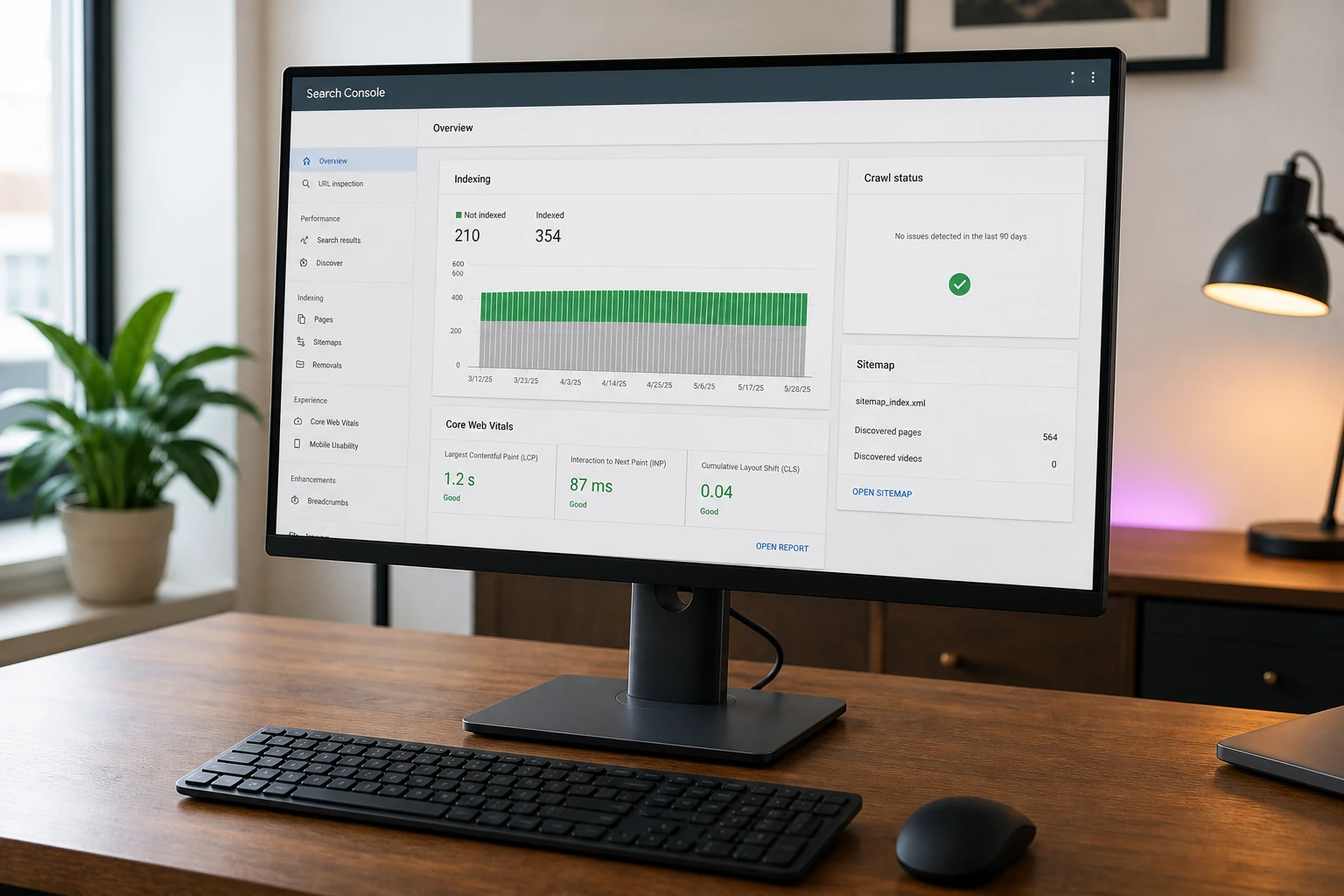
Almost every engagement starts here. An audit is how we find out what is quietly holding your rankings back before anyone writes a single new page — because publishing more content on a site search engines struggle to crawl is an expensive way to stand still.
We crawl the site the way a search engine does, compare that against what is actually indexed, read the history in your analytics and Search Console, and then rank what we find by impact. You end up with a short list you can act on, not a 60-page PDF that gets filed and forgotten.
What the audit covers
Five areas, each of which regularly turns out to be the reason a site is stuck. We look at all of them, then tell you which ones matter for you specifically.
Crawling and indexation
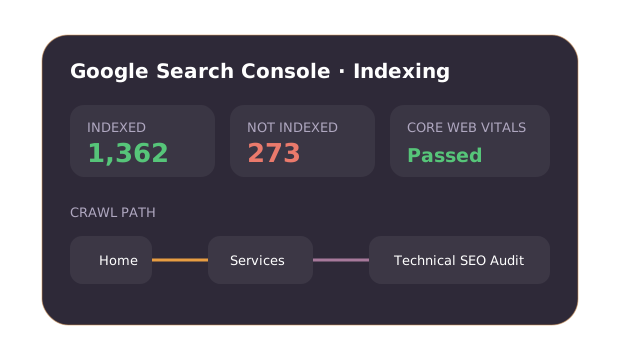
Which pages search engines can reach, which they choose to index, and where crawl budget is being spent on pages that will never earn a visit.
Site architecture and internal links
How authority flows through your site, which important pages are buried four clicks deep, and where two pages are quietly competing for the same query.
On-page fundamentals
Page titles, headings, structured data and content depth, checked against the pages currently outranking you rather than against a generic checklist.
Performance and Core Web Vitals
Real-world load behaviour on mobile, with fixes ranked by the effort your developers will actually need to spend.
History and risk
Past migrations, redirect chains, manual actions, duplicate domains, stray staging environments — the things that explain a drop nobody could account for.
Competitive gap
Which queries your competitors own, what their pages do differently, and where the realistic openings are for you.
87%

- of audited sites have crawl or indexing issues nobody knew about
What you actually receive
The audit is a working document, not a deliverable for the shelf. It is written so a developer, a marketer and a founder can each read the part they need.
- A prioritised list of the top five issues hurting your visibility, with the reasoning attached
- Full findings grouped by area, each with severity, effort and expected impact
- Implementation notes your developers can work from directly
- A crawl comparison showing what search engines see versus what you think they see
- A 90-day plan for what happens after the fixes land
- A walkthrough call where we go through the findings with your team

Priorities you can defend
When someone asks why this ticket is above that one, the answer is written down, with the impact estimate that produced it.

No busywork
We deliberately leave low-impact findings out of the priority list. Fixing forty trivial issues does not move rankings.
How the audit runs
Around two to three weeks from kickoff to walkthrough, depending on the size of the site and how quickly we get access to analytics and Search Console.
Audit process

Week one: access, crawl and data collection. Week two: analysis, competitive comparison and prioritisation. Week three: the write-up and the walkthrough call, followed by a short implementation plan agreed with whoever will be doing the work. If your team wants us to implement the fixes rather than spec them, that becomes the next phase of work.
after crawl and indexation fixes
A note on timelines and pricing
Meaningful ranking movement usually takes three to six months, because search engines need time to crawl the changes and reassess the site. We'd rather say that now than surprise you in week six.
There are no fixed packages here. Scope, effort and price are agreed after we've looked at your site — send a request and you'll get a proposal built for your situation.
Frequently asked questions
Often yes, and it is cheaper then. A short structural review before you publish 50 pages saves you from consolidating them later.
We can, or we can hand your developers a specification and review the result. Both work — it depends on where your team has capacity.
Indexation issues can resolve in days. Ranking movement generally takes three to six months, since search engines need time to recrawl and reassess the site.
Read access to Google Search Console and your analytics, plus a way to crawl the site. If a staging environment exists, access to that helps too.
