


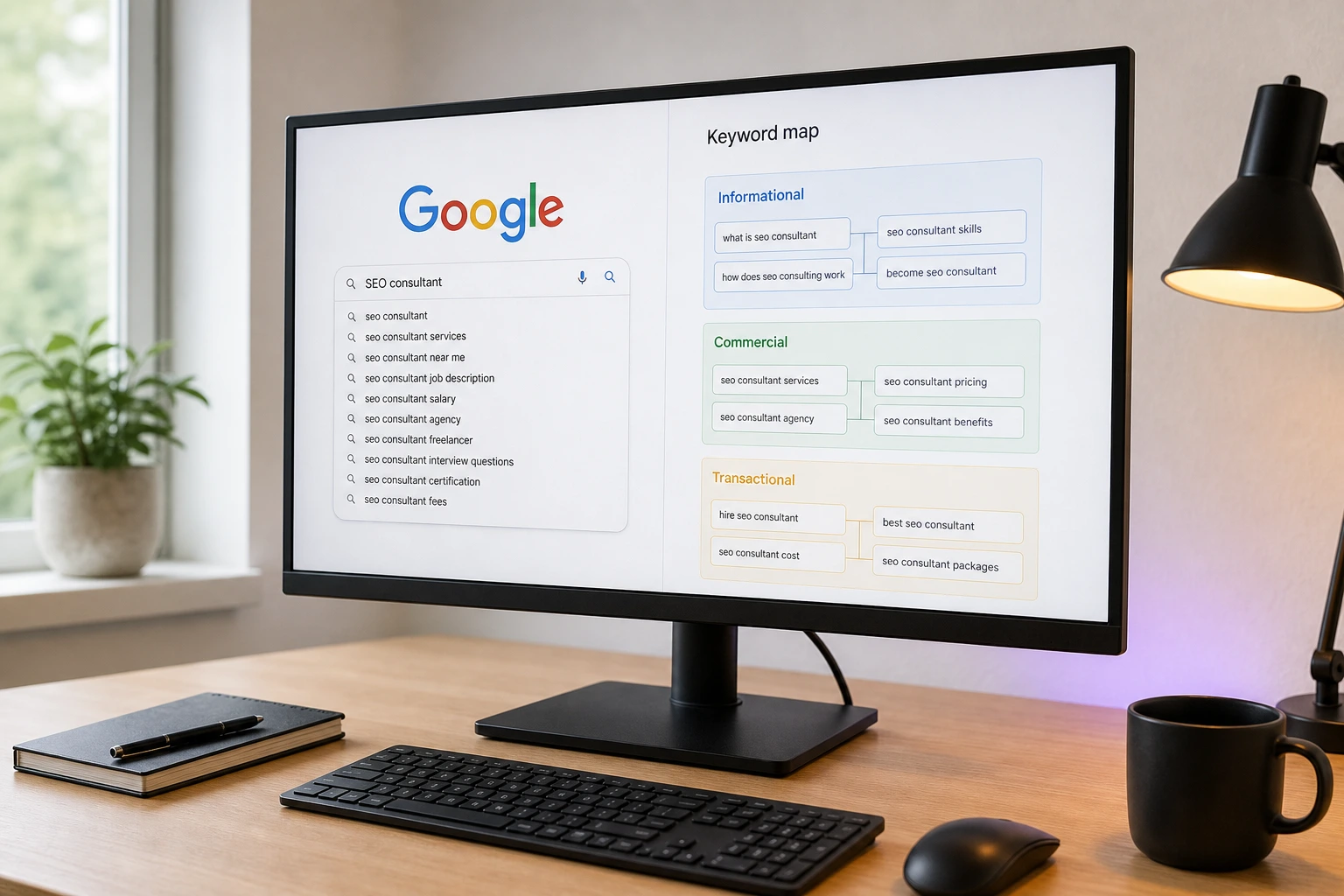
Mapping out the right keywords to target is the part of SEO that decides whether everything after it pays off. Rank for the wrong queries and you get traffic that never converts; chase queries you cannot realistically win and you spend a year going nowhere.
We build a keyword map: every target query matched to the intent behind it, assigned to exactly one page, and ordered by how quickly it can realistically move. Your writers stop guessing what to write, and your pages stop competing with each other.
From research to a usable map
A spreadsheet of 4,000 keywords is not a strategy. The value is in the filtering, the intent classification and the mapping — which is where most of our time goes.
Demand research
Seed terms, competitor visibility, Search Console queries you already half-rank for, and the questions your sales team hears every week.
Intent classification
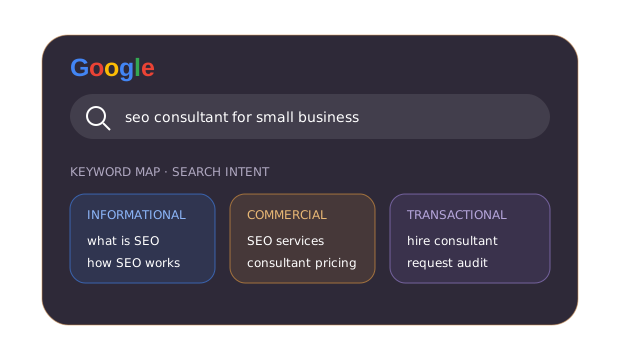
Informational, commercial, transactional or navigational — checked against what actually ranks today, not against assumptions.
Winnability scoring
Honest assessment of which queries your domain can compete for now, which need authority first, and which are not worth the effort at all.
One page, one job
Each target query is assigned to a single page. Where two pages overlap, we decide which one wins and what happens to the other.
Gap and cluster analysis
Topic clusters that show where you need new pages, and where an existing page just needs to be better.
Priority sequencing
Quick wins first — pages ranking on positions 5–15 usually move fastest — then the longer plays.
74%

- of sites we review have pages competing for the same keyword
What you actually receive
Everything lands in one document your team can work from for the next year, not a research dump you have to interpret.
- A keyword map: query, intent, target page, current position, priority
- Topic clusters showing which pages support which pillar
- A cannibalisation list with a decision for every overlap — merge, redirect or differentiate
- A ranked backlog of pages to create, rewrite or consolidate
- Tracking set up for the queries that matter, so progress is visible
- A working session with your marketing and content team

Writers know what to write
Every brief starts from a target query, an intent and a page that already has a defined role in the site.

Fewer pages, better rankings
Consolidating overlapping pages frequently lifts rankings without a single new article being published.
How the mapping works
Usually two weeks. It runs well alongside an audit, since architecture problems and keyword problems tend to be the same problem seen from different angles.
Research process

We start from your existing visibility rather than a blank page — the queries you already rank for on positions five to fifteen are almost always the fastest route to more traffic. From there we widen into competitor gaps and unserved intent, score everything for winnability, then map it page by page. The output gets reviewed with your team before it is final, because you know your market and your margins better than any tool does.
after intent mapping and page alignment
A note on timelines and pricing
Meaningful ranking movement usually takes three to six months, because search engines need time to crawl the changes and reassess the site. We'd rather say that now than surprise you in week six.
There are no fixed packages here. Scope, effort and price are agreed after we've looked at your site — send a request and you'll get a proposal built for your situation.
Frequently asked questions
No. A large share of the map is usually served by improving or merging pages you already have.
Fewer than most tools suggest. A focused map of realistic queries beats a list of thousands you will never address.
Yes. If you have research already, we validate it, classify intent and turn it into a map rather than starting from scratch.
Paid data is useful evidence — it shows which queries convert. We use it where you have it, but organic intent and paid intent are not always the same thing.
