


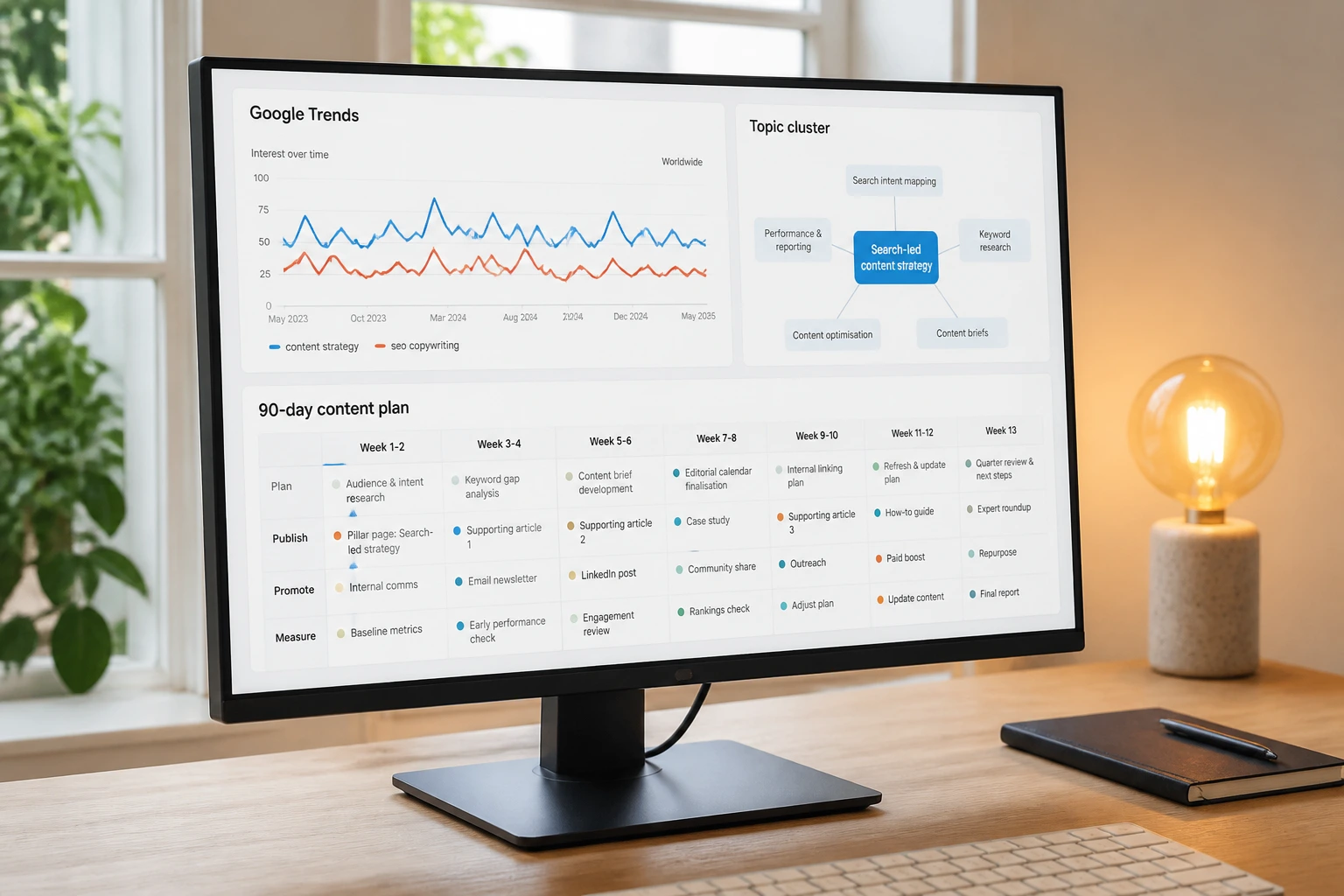
Creating a plan for new content is one of the core jobs of an SEO consultant, and it is where most content budgets are wasted. Publishing weekly because someone decided weekly was the cadence produces a library of pages nobody searches for and nobody links to.
We start from demand: which questions your buyers actually type, which of those you can realistically win, and which existing pages should be improved instead of duplicated. Then we plan 90 days of work with a clear owner for every piece.
A plan, then briefs
Strategy without briefs stays theoretical. We hand over both, so the plan survives contact with a real editorial calendar.
Demand-led planning
Every planned piece is tied to a query with real search volume and an intent your business can serve.
Create, improve or merge
For each topic we decide whether it needs a new page, a rewrite of an existing one, or a consolidation of several.
Pillar and cluster structure
A main page for the head term, supporting pieces for the long tail, and internal links tying them together.
Briefs writers can use
Target query, intent, angle, required sections, questions to answer, internal links and the pages currently ranking.
SEO copy and editing
We write or edit the priority pieces where you need the standard set, then hand the pattern back to your team.
Refresh schedule
Existing pages decay. We flag which ones to update, when, and what to change.
90

- days of planned content and link-building work agreed upfront
What you actually receive
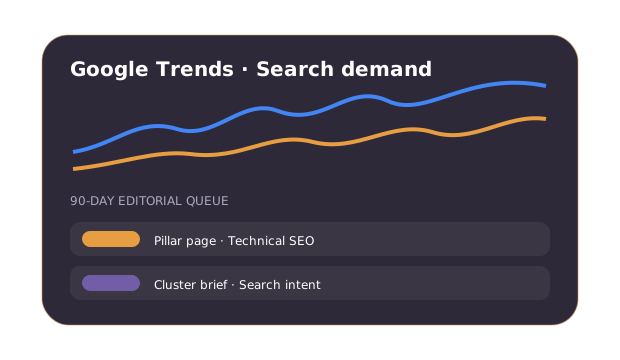
The output is an editorial plan your team can run, whether or not we write a single word ourselves.
- A 90-day content plan with owners, formats and publication dates
- A brief for every planned piece, ready to hand to a writer
- A consolidation list: which existing pages merge, redirect or retire
- A refresh calendar for pages that are decaying
- Optional: we write or edit the priority pieces ourselves
- A short style and structure guide so new pieces stay consistent

Publish less, rank more
Most sites we work with cut their output and grow, because effort moves from volume to pages that can win.

Content that earns links
Pieces planned around genuine gaps attract references naturally — which is what makes link building possible at all.
How planning runs
Two weeks to build the plan, then a working rhythm of monthly reviews as pieces ship and the data comes back.
Editorial rhythm

The first plan covers 90 days because that is roughly how long it takes to know whether a direction is working. Each month we review what published, what moved, and what the search results are telling us — then adjust the remaining queue. Pieces that underperform are diagnosed rather than abandoned: often the issue is intent mismatch or a missing internal link, not the writing.
from demand-led content published to plan
A note on timelines and pricing
Meaningful ranking movement usually takes three to six months, because search engines need time to crawl the changes and reassess the site. We'd rather say that now than surprise you in week six.
There are no fixed packages here. Scope, effort and price are agreed after we've looked at your site — send a request and you'll get a proposal built for your situation.
Frequently asked questions
We can write the priority pieces, or brief and edit while your team or your agency writes. Both work; the briefs are the important part.
Used carefully as a drafting aid, fine. Used to mass-produce pages, it tends to create exactly the thin, undifferentiated library that consolidation projects later have to clean up.
As often as you can publish something genuinely better than what ranks now. For most teams that is less frequently than they currently do.
Typically three to six months, sometimes faster on lower-competition queries and on sites with existing authority.
